Designing the Off-Grid Command Center
The design philosophy behind our tactical command center in a box — what it is, why it exists, and how we're approaching the engineering challenges.
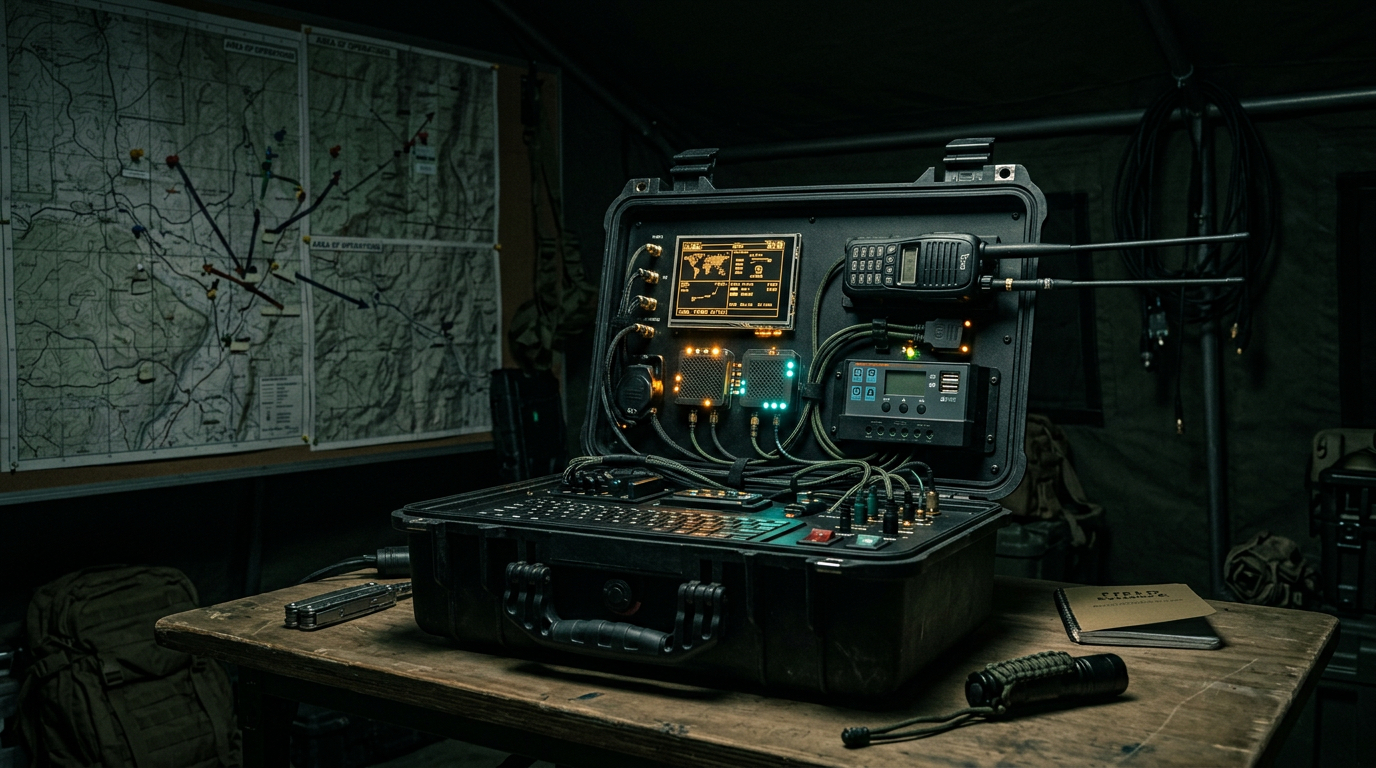
The concept is simple: put everything you need to coordinate, communicate, and make informed decisions into a box you can carry. The engineering is anything but.
The Problem Space
In a grid-down scenario, you lose more than electricity. You lose access to the entire information infrastructure that modern society depends on. Maps, medical references, communication, weather data, supply chain logistics — all gone in an instant.
Existing solutions address pieces of the puzzle. A satellite communicator gives you messaging. A solar panel gives you power. A survival book gives you reference material. But nobody has integrated these into a coherent system that works as a unified platform.
Design Principles
We established five non-negotiable design principles early in the process:
- Fully autonomous — The system must provide full capability with zero external dependencies. No cloud, no cellular, no internet.
- Carry-portable — It needs to fit in a pack. Target form factor is roughly the size of a thick hardcover book.
- Extended runtime — Minimum 12 hours on internal battery, indefinite runtime with a modest solar setup.
- Expandable — One unit is useful. Multiple networked units are transformative. The architecture must support seamless scaling.
- Ruggedized — It needs to survive the conditions you’re surviving. Water, dust, drops, temperature extremes.
Architecture Overview
The system is built around three core subsystems:
Compute & AI
An edge AI processor running our custom-trained survival models, with enough storage for the complete knowledge base. The AI isn’t a gimmick — it’s the primary interface for accessing the system’s capabilities.
Communications
Integrated MANET radio for mesh networking, WiFi for local device connectivity, and BLE for sensor integration. The communication stack is designed to be the backbone of an expandable network.
Power
Internal LiFePO4 battery (chosen for temperature tolerance and cycle life) with USB-C PD input for charging from any source, and direct solar input for field deployment.
Current Status
We’re in the detailed design phase, working through component selection, thermal management, and enclosure design. The AI subsystem is furthest along — we have working models running on target hardware. The next major milestone is our first integrated prototype bringing all three subsystems together in the target form factor.