Why Mesh Networking Matters for Everyone
Mobile ad-hoc networks aren't just for the military anymore. Here's why civilian MANET systems are critical infrastructure for disaster preparedness.
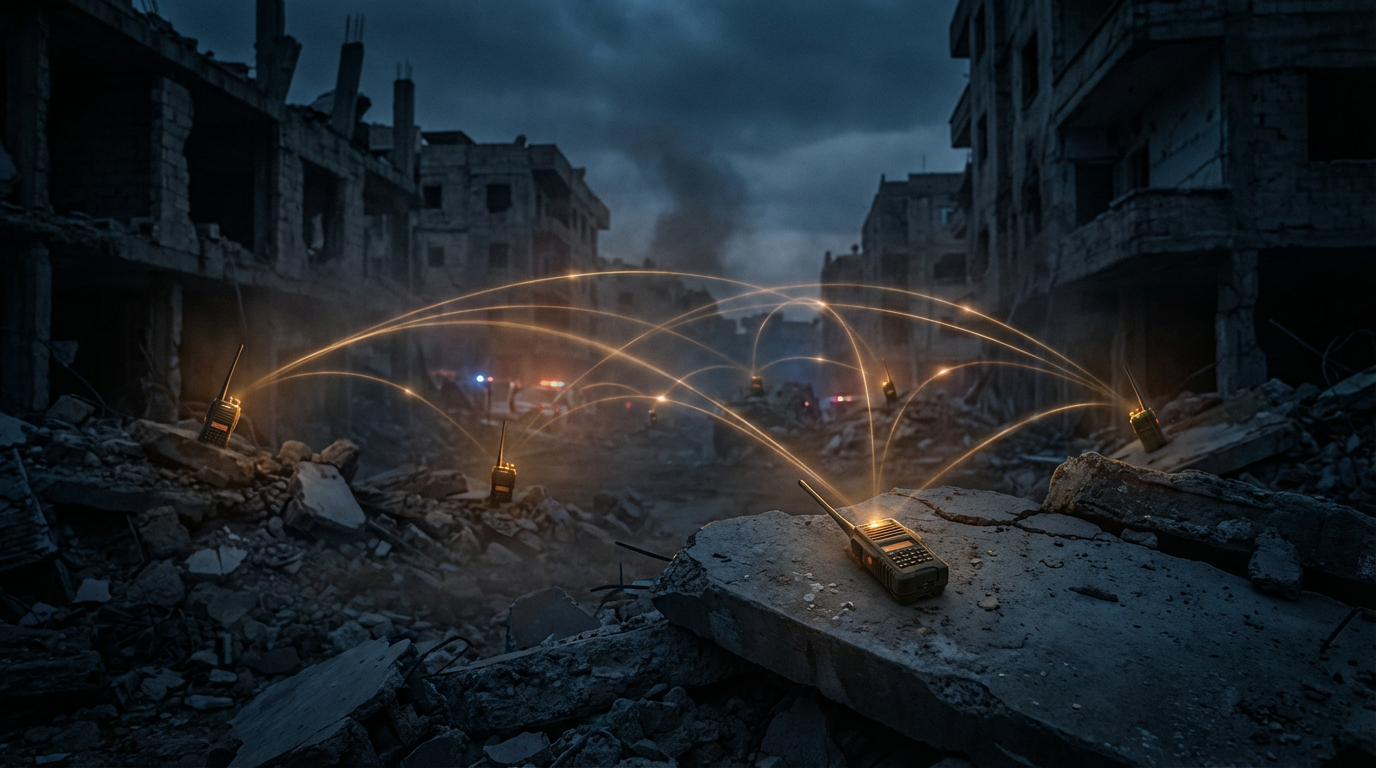
When Hurricane Maria hit Puerto Rico in 2017, 95% of cell towers were knocked out. Communication — the single most critical capability for coordinating rescue, distributing supplies, and maintaining order — vanished instantly for 3.4 million people.
This isn’t an edge case. It’s the default scenario for any serious disaster. And it’s the scenario we’re building for.
What is a MANET?
A Mobile Ad-hoc Network (MANET) is a self-configuring network of mobile devices connected wirelessly. Unlike traditional networks that depend on fixed infrastructure — cell towers, routers, fiber lines — a MANET creates its own infrastructure on the fly.
Every device in the network serves dual duty: it’s both a communication endpoint and a relay node. When you send a message, it hops from device to device until it reaches the recipient. No towers. No internet. No single point of failure.
Why Traditional Solutions Fail
Satellite phones work, but they cost $1-2 per minute, require line-of-sight to the sky, and don’t support data-heavy applications. They’re point-to-point, not networked.
Ham radio is excellent for long-range voice, but requires licensing, dedicated equipment, and significant training. It doesn’t integrate well with modern data applications.
Consumer radios (FRS/GMRS) have limited range, no encryption, and no networking capability. They’re fine for a hiking trip, not for coordinating disaster response across a community.
Our Civilian Approach
Military MANET systems solve these problems, but they cost tens of thousands of dollars per node and require specialized training. We’re building civilian-grade mesh networking that’s:
- Affordable — Target price point accessible to preparedness-minded civilians
- Simple — Power on, communicate. No configuration, no licensing required
- Secure — AES-256 encryption with curve25519 key exchange. No cleartext, ever
- Expandable — Each node you add extends the network’s range and resilience
- Integrated — Works seamlessly with the Atalias Command Center and AI systems
The Network Effect
Here’s what makes mesh networking uniquely powerful: it gets better as more people adopt it. One node has limited range. Ten nodes cover a neighborhood. A hundred nodes cover a town. The network becomes community infrastructure — resilient, distributed, and owned by the people who use it.
Building It
We’re currently prototyping on 900 MHz ISM band hardware, which gives us good range through obstacles and foliage without requiring any license. The protocol stack handles automatic peer discovery, optimal routing, and seamless relay — all transparent to the user. You just send messages and the network figures out how to deliver them.